
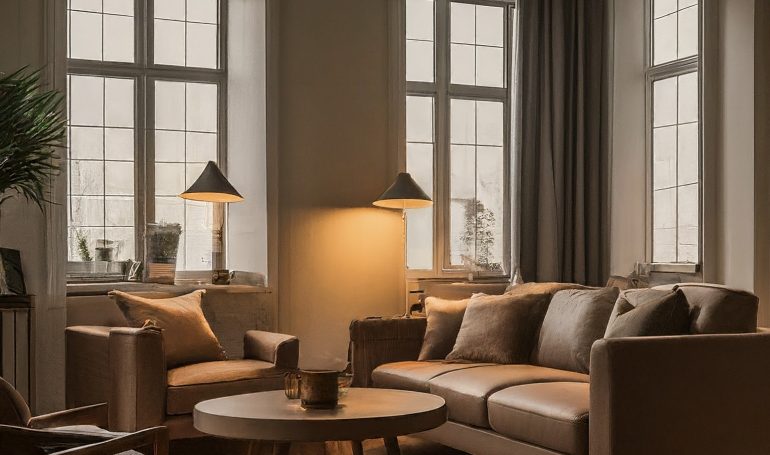

Lighting can change your life.
That may sound dramatic, but when you’ve lived in spaces that feel heavy, uncomfortable, or constantly “off,” you know it’s true. Light affects how we move, how we rest, how we focus, and how we experience our homes day after day.
Most people think about lighting as something decorative or secondary.
A fixture to choose once everything else is done. In reality, lighting works best when it supports the space, its function, and the life happening inside it.
When lighting is intentional, rooms feel clearer, calmer, and easier to live in. When it isn’t, even beautiful spaces can feel stressful or unfinished.
Lighting as Part of a Bigger Strategy
Lighting is not the starting point of a design, but it’s not the last detail either. It sits in the middle of the process, after understanding how a space is used and after defining layout, proportions, and style. Lighting responds to all of that. It supports decisions already made and helps the space function as intended.
That’s why copying lighting ideas from the internet often doesn’t work.
The same fixture can feel completely different depending on ceiling height, room size, finishes, and how the space is actually used. Without context, lighting becomes decoration instead of design.
In interior design, we rely on three main types of lighting to create balance and clarity.
The Three Types of Lighting Every Home Needs
General Lighting (Ambient)
General lighting is the main source of light in a room.
It provides overall illumination and allows the space to function comfortably.
This layer usually comes from ceiling-mounted fixtures, recessed lights, or flush and semi-flush fixtures. It sets the base of the room.
Without it, spaces often feel uneven or difficult to use, no matter how many lamps are added later.
Task Lighting
Task lighting is focused and practical. It supports specific activities that require visibility and precision. Under-cabinet lighting in kitchens, reading lamps, desk lights, and vanity lighting are all examples. This layer reduces strain and makes everyday routines easier and more efficient.
Accent Lighting
Accent lighting adds depth and visual interest.
It highlights architectural features, textures, artwork, or specific areas you want to bring forward.
Wall sconces, picture lights, shelf lighting, and directional spotlights help create contrast and dimension, often making the difference between a space that feels flat and one that feels intentional.
Decorative fixtures are not a separate lighting type.
They can act as general or accent lighting depending on how they are used.
Their role is both functional and visual.
Why Layered Lighting Matters
One light source is never enough, a room lit only from the ceiling often feels harsh or incomplete. When general, task, and accent lighting work together, the space becomes flexible.
It adapts to different moments of the day, different activities, and different moods.
Lighting doesn’t fix a space that lacks clarity. It amplifies what’s already there.
When layout and function make sense, lighting enhances them.
When they don’t, lighting often reveals the problem.
A Final Thought
If your home feels uncomfortable, overwhelming, or difficult to enjoy, lighting is often part of the reason, not because it’s wrong on its own, but because it hasn’t been considered in relation to how you live.
Good lighting supports your space.
Great lighting supports your life.
If you’d like help understanding how lighting fits into your home in a way that feels intentional and personal, I’d love to support you.